
PLAN Health Advocacy and Development Foundation (PLAN Foundation) has recorded significant progress in the implementation of its Accelerating Community Commitment towards Ensuring Safer Services for the Reproductive Health of Women and Girls in Oyo State (ACCESS) Project, with growing stakeholder engagement, strengthened institutional partnerships, and improved capacity among frontline actors working to advance reproductive health outcomes in Oyo State. The achievements were highlighted in the Period One Project Data Report, which captures major milestones reached during the reporting period.
Implemented with support from AmplifyChange, the ACCESS Project seeks to strengthen community and institutional commitment to safer reproductive health services for women and girls through advocacy, evidence generation, stakeholder engagement, and expanded access to reproductive health information and services.
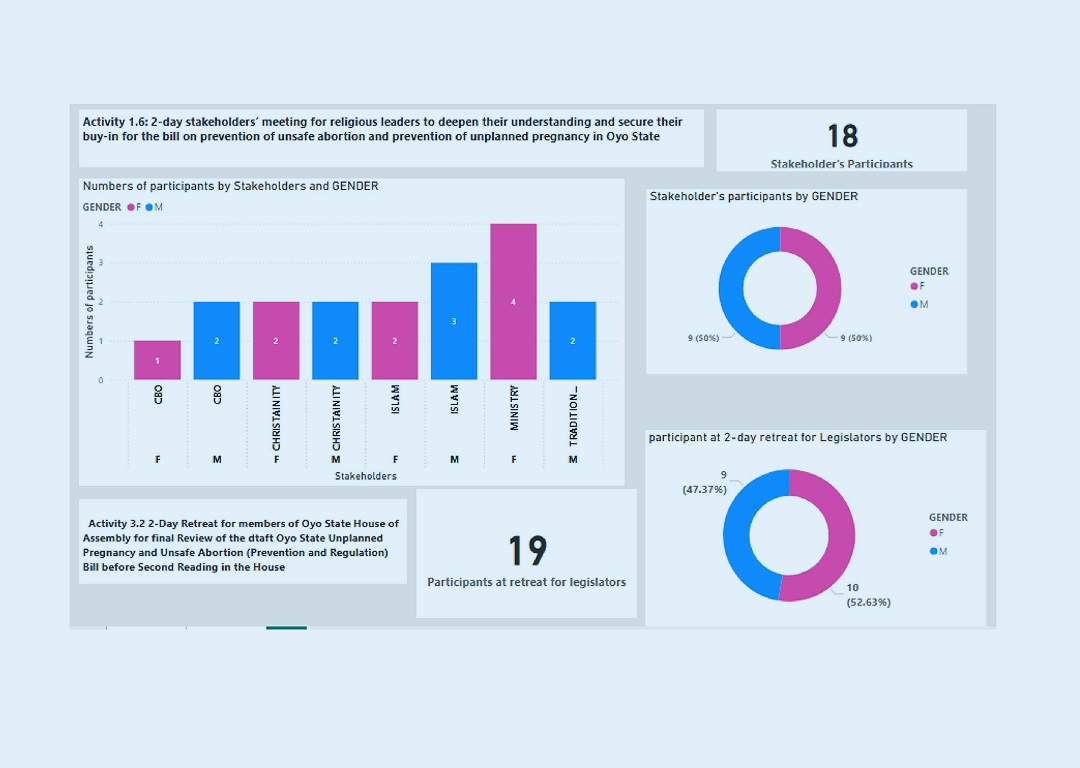
One of the project’s major achievements during the reporting period was strengthened engagement with policymakers and government institutions. A total of 19 legislators and government stakeholders participated in a policy retreat on the draft Oyo State Unplanned Pregnancy and Unsafe Abortion (Prevention and Regulation) Bill, helping to deepen understanding and strengthen legislative dialogue ahead of further legislative consideration. Participation reflected strong inclusiveness, with near gender balance among attendees.
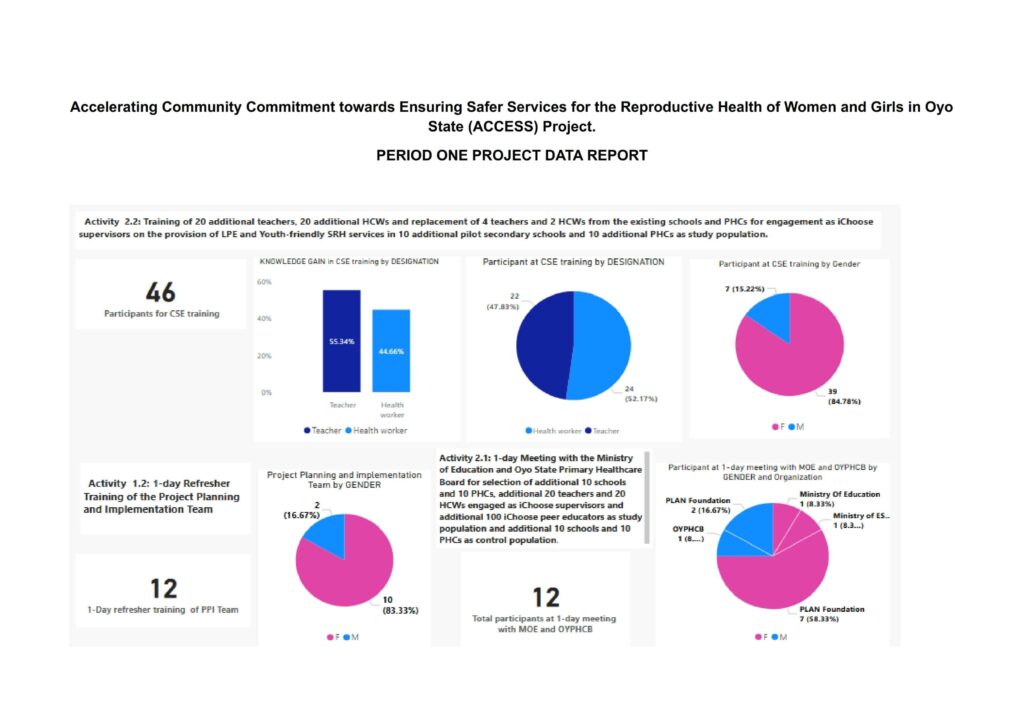
The above infographics visually summarize stakeholder engagement activities involving legislators, religious leaders, education and health sector representatives, as well as project implementation teams.
The data reported showed that:
- 19 persons including legislators and government stakeholders participated in the policy retreat on the draft
Unplanned Pregnancy and Unsafe Abortion Bill in Oyo State, with near gender balance (10 females and 9 males).- 18 representatives across religious, ministries representatives and community leaders were engaged across Christian,
Islamic, and Traditional institutions to strengthen advocacy and community dialogue on reproductive health issues.- 12 representatives from the Ministry of Education, Oyo State Primary Health Care Board (OYPHCB), and partner
institutions participated in coordination and implementation meetings, with women representing 75% of
participants.- The Project Planning and Implementation technical engagement team included 12 multi-sector stakeholders from
education, health, and legislative institutions.- A total of 46 participants attended the Comprehensive Sexuality Education (CSE) training, comprising 39 females and
7 males. Analysis of pre- and post-test assessments indicated significant knowledge improvement, with average
scores increasing from 84% to 93%, demonstrating enhanced participant understanding and learning outcomes.
These quarterly infographics enhanced public awareness, strengthened stakeholder engagement, improved information dissemination, and increased visibility of PLAN Foundation’s interventions and impact during this quarter. The visual reports also supported evidence-based advocacy, donor communication, and strategic program reporting by presenting complex project data in accessible and engaging formats for diverse audiences.
Recognizing the important role of faith and community leaders in shaping public attitudes, the project also convened a two-day stakeholders’ meeting involving 18 religious leaders, ministry representatives, and community stakeholders drawn from Christian, Muslim, and traditional institutions. The engagement strengthened dialogue on reproductive health issues and helped build wider support for advocacy around prevention of unplanned pregnancy and unsafe abortion in Oyo State.
The ACCESS Project also prioritized institutional coordination and technical strengthening. Representatives from the Oyo State Ministry of Education, Oyo State Primary Health Care Board (OYPHCB), and partner organizations participated in planning and coordination meetings aimed at strengthening implementation of Life Planning Education (LPE) and youth-friendly sexual and reproductive health interventions in schools and primary healthcare facilities. Women accounted for the majority of participants in these coordination efforts, reflecting strong female representation in project implementation structures.
As part of efforts to improve adolescent reproductive health education, the project trained 46 teachers and healthcare workers to support delivery of Comprehensive Sexuality Education (CSE) and youth-friendly services across additional schools and primary healthcare facilities. Data from pre- and post-training assessments showed measurable improvement in participant knowledge, with average scores increasing from 84% to 93%, demonstrating strengthened technical understanding among participants. Female participation was also notably high, reinforcing the project’s commitment to gender-responsive implementation.
Speaking on the progress recorded, PLAN Foundation reaffirmed its commitment to working with government agencies, legislators, faith leaders, schools, healthcare institutions, and communities to improve reproductive health outcomes for women and girls in Oyo State. The organization noted that evidence generated through the ACCESS Project will continue to support advocacy, policy engagement, and implementation of sustainable reproductive health interventions.
The quarterly data report also underscores the value of visual reporting and evidence-based communication in strengthening transparency, stakeholder engagement, and donor accountability. By translating project data into accessible formats, the ACCESS Project continues to support informed decision-making and wider public understanding of efforts to advance safer reproductive health services in Oyo State.
PLAN Foundation is a member of the International Association of Providers of AIDS Care (IAPAC), the World Patients Alliance (WPA), the International AIDS Society (IAS), the Global Network of People Living with HIV (GNP+), the Stop TB Partnership, the International Alliance of Patients’ Organizations (IAPO), the International Union Against Tuberculosis and Lung Diseases (IUATLD), the Global Health Council (GHC), as well as various other relevant regional and global networks, movements, and professional associations aligned with its vision of a Nigeria where the individual, family, and community are adequately empowered to protect themselves against poverty, underdevelopment, and the spread of diseases.
For more details on PLAN Foundation, engage us on our social media accounts on
X (Twitter): @NG_PLAN
Instagram: @planfoundationng
Facebook: @PLANFoundationNG
YouTube: @PLANFoundationNG


